GreenLetter XIII: Building the Roadmap for India's High-Efficiency Ceiling Fan Market
India has 585 million ceiling fans in use today. By 2037–38, that number crosses 950 million. GreenTree and NRDC India spent the recent year building CF30 — a strategic roadmap to ensure that growth doesn't compound India's energy burden. The roadmap was released in March 2026.
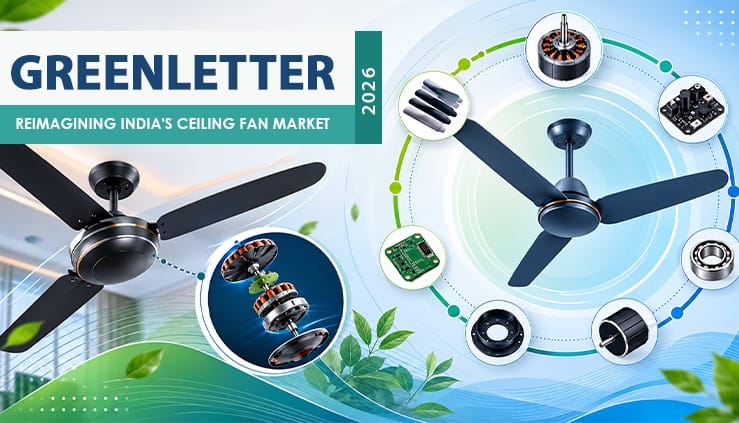
India has 585 million ceiling fans in use today. By 2037–38, that number crosses 950 million. GreenTree and NRDC India spent the recent year building CF30 — a strategic roadmap to ensure that growth doesn't compound India's energy burden. The roadmap was released in March 2026.
GreenTree led the technical modelling, market analysis, cost trajectory projections, localization gap assessment, and intervention design across all four pillars of the CF30 Blueprint — co-produced with NRDC India and presented to the Department of Science and Technology.
|
585M Ceiling fans in use in India today |
77% Of fans sold in 2022–23 were 1-star rated |
20 TWh Potential annual energy savings by 2037–38 |
Ceiling fans are present in nearly 90 percent of Indian homes, running eight to ten hours a day in households that cannot afford not to use them. They account for roughly 40 percent of residential electricity consumption — and they are one of the largest untapped opportunities for demand-side energy savings in the country.
Yet in 2022–23, 77 percent of all ceiling fans sold were 1-star rated — consuming 53 watts each. A current 5-star BLDC fan consumes 28 watts. By 2030, with the right R&D investment and manufacturing scale, that could come down to 20 watts. Multiplied across 950 million fans running daily, this is not an incremental efficiency gain. It is a structural shift in India's residential energy demand curve.
This is the problem GreenTree set out to address through the CF30 Blueprint — and the scale of it is why we believe this is among the most consequential energy efficiency interventions available to India right now.
The efficiency gap is real – and Affordable Efficiency is Within Reach
The CF30 vision aims to make high-efficiency fans the new market standard. By 2030, even the most affordable ceiling fans are likely to have a minimum Service Value (SV) of 6 – equivalent to today's 5-star efficiency – while costing similar to the price of a current 1-star fan. CF30 roadmap envisions that a 5-star fan can reach a Service Value of 10 by 2030, consuming just 21 watts. GreenTree's cost modelling shows manufacturing costs for 5-star fans have already fallen 30 percent since 2020, and controller costs are projected to fall a further 25 percent by 2030.
Let's Calculate Your Savings
Enter your organisation's fan count and the wattage of your current fans to see potential energy and cost savings under CF30-compliant fans. Takes 10 seconds.
Typical range 35–75W. Old induction fans commonly draw 70–75W; 5-star rated draw ~35W.
These are indicative estimates based on CF30's 21W target fan. Want a detailed savings analysis for your organisation's procurement or DSM programme? Talk to GreenTree →
This tool is personalised for Green Letter subscribers. Usage is recorded by GreenTree Global to serve you better. Contact us to opt out.
What GreenTree built – and how
The CF30 Blueprint is not a policy wish list. It is a grounded, technically modelled, stakeholder-validated roadmap. GreenTree's work spanned the full value chain: market sizing and technology benchmarking, motor efficiency modelling, bill-of-materials cost breakdowns for both induction and BLDC fans, localization gap mapping across magnets, controllers, and electrical steel, and a structured prioritisation framework that sequences all thirteen interventions by policy alignment, technical feasibility, and implementation readiness.
This was built through a DST kick-off workshop, followed by one-on-one consultations with eleven organisations — MSMEs, large manufacturers including Crompton, Havells, and Bajaj Electricals, component suppliers, IIT Bombay, and IFMA. Findings were presented at the World Bank–DST AHEAD workshop in May 2025.
The result is four interconnected intervention pillars:
|
PILLAR
01 Design &
material innovation Thinner stator laminations (0.35mm), CRNO
electrical steel, copper windings, composite blades. GreenTree's modelling
shows these can lift induction fan SV from 6 to 7.4, and BLDC from 7.5 to
8.3. |
PILLAR
02 Enhanced testing
standards Standardising ambient testing conditions and
codifying controller durability (50,000-hour lifespan) under IS 374 — closing
the compliance gap that allows substandard products to undercut the S&L
programme. |
|
PILLAR
03 Demand creation DSM-linked replacement programmes, mandated public
procurement, graded GST (5% for 5-star vs 18% for 1-star), and a multilingual
consumer awareness campaign. Together these reduce the effective price
premium to near zero. |
PILLAR
04 Ecosystem
development Cluster-level NABL testing, IIT-to-MSME Centers of
Excellence, PLI (Production Linked Incentive) extension for CRNO steel and
electronics, and concessional financing for domestic magnet processing
through sintering. |
Cold Rolled Non-Oriented (CRNO) Electrical Steel is a specialized magnetic steel used in electric motors. It offers low core losses and high magnetic permeability, enabling motors to operate more efficiently with lower heat generation
The supply chain gap that limits scale
GreenTree's localization analysis surfaced a vulnerability the broader policy conversation has underweighted. The BLDC fan supply chain is deeply import-dependent – not in one component but across all critical inputs simultaneously. India continues to rely heavily on imports for several critical components used in high-efficiency ceiling fans. Nearly all CRNO electrical steel and integrated circuits are imported, while 90–95% of ferrite magnets and 75–80% of the components used in motor controller PCBs are sourced from China and Taiwan.
CF30 targets 80 percent localization across the BLDC fan value chain by 2030. Getting there requires PLI extension into electrical steel and electronics, concessional financing for domestic magnet processing, and integrated manufacturing clusters. Without this, demand-side interventions will accelerate sales of fans that remain import-dependent — a half-solved problem.
How interventions are sequenced
One of our core contributions to CF30 was the prioritisation framework — a structured assessment of all fourteen interventions across policy alignment, technical correctness, and implementation feasibility. The sequencing that emerged is deliberate:
|
0–2 yrs Near-term |
Standardisation and demand stimulation
Update IS 374 for ambient testing and controller durability. Launch DISCOM-led fan replacement programmes. Mandate public procurement of 5-star fans. Introduce graded GST. These require regulatory will, not capital investment.
|
|
3–5 yrs Medium |
Design optimisation and domestic manufacturing
Reduce import duties on electrical-grade steel. Provide concessional financing for material R&D. Introduce PLI for CRNO steel and electronics. Launch the industry-academia innovation challenge.
|
|
5+ yrs Long-term |
Structural ecosystem development
Establish cluster-level NABL testing facilities and Centers of Excellence. Build integrated fan manufacturing clusters. Scale domestic magnet processing through sintering technology.
|
What next?
CF30 surfaced a clear pattern: India's ceiling fan ambitions are ultimately blocked by deeper, shared constraints — component-level R&D, testing infrastructure, and domestic manufacturing capability that extend well beyond fans alone. The localization gaps we mapped aren't unique to ceiling fans. They sit at the core of a much wider challenge facing India's cooling and thermal manufacturing base.
Next, we are working to develop a broader national initiative aimed at strengthening India's cooling and thermal innovation ecosystem. The objective is to evaluate aspects including shared testing and validation infrastructure, stronger academia-industry R&D pathways, and coordinated sourcing for domestic component manufacturing.
This phase presents an opportunity to move beyond strategy development towards implementation, strengthening institutional and industrial capacity not only within the ceiling fan sector but across the broader cooling manufacturing ecosystem that is critical to achieving the vision.
If this is a space you're thinking about too — component manufacturing, testing infrastructure, or applied cooling R&D — we would love to speak!
DSM Implementation | MSME Decarbonization | Appliance Standards | Energy Efficiency MRV | GHG Accounting | ESG Reporting
About the CF30 Blueprint: Blueprint for Advancing Affordable and Domestically Produced Super-Efficient Ceiling Fans in India was co-produced by GreenTree and NRDC India, released March 2026.
Greenletter is GreenTree's periodic newsletter on energy efficiency, sustainability, and market transformation across India's buildings and industry sectors.