GreenLetter XIV: Building the Roadmap for India's Green Steel Transition
India's steel sector emits 10–12% of the country's total greenhouse gases and with crude steel production set to nearly double toward the National Steel Policy's 300 MTPA target by 2030–31, that burden will only grow.
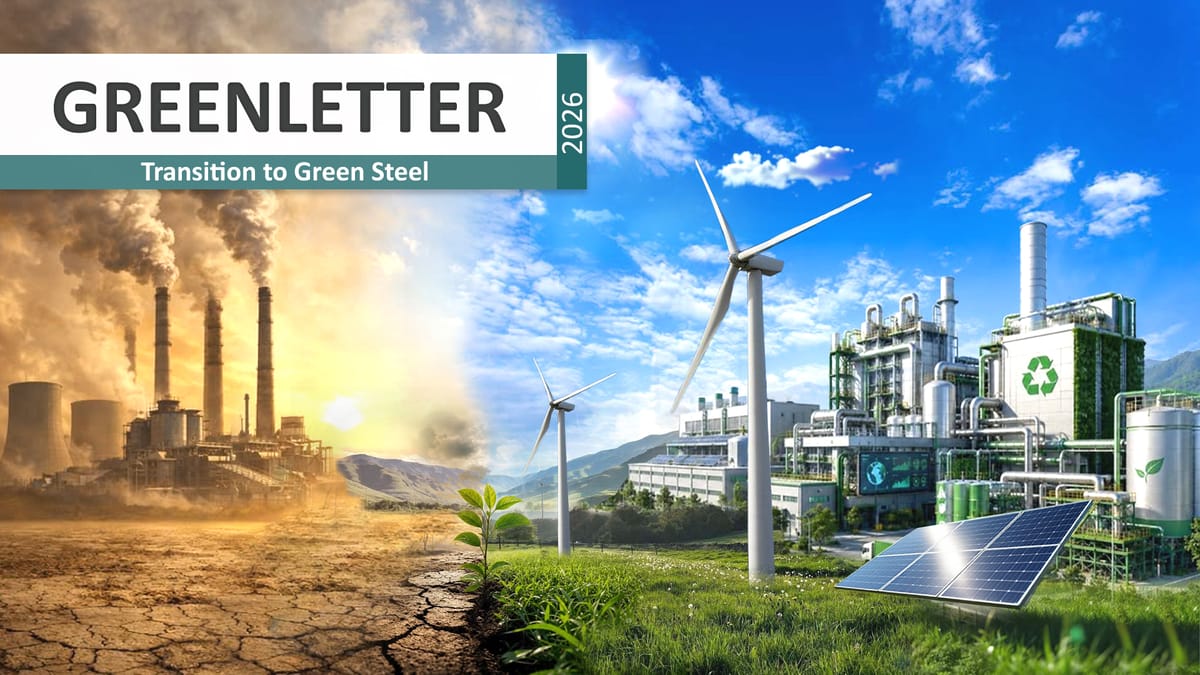
India's steel sector emits 10–12% of the country's total greenhouse gases and with crude steel production set to nearly double toward the National Steel Policy's 300 MTPA target by 2030–31 [1], that burden will only grow. This GreenLetter lays out the technologies, costs, and policy sequencing needed to make green steel commercially viable at scale in India.
The scale of the challenge
India is the world's second-largest crude steel producer, contributing approximately 7.4% of global output, with an installed capacity of 179.5 million tonnes (MT) and production of 144.3 MT in FY 2023–24 [2]. The sector contributes around 2% of India's GDP [3] but its emissions intensity remains among the highest globally, driven by heavy reliance on coal-based routes and grid electricity.
Steel demand is led by construction (43%), infrastructure (25%), engineering/ packaging/white goods (22%), automobiles (9%), and defence (1%). India's installed capacity splits roughly 56% Integrated Steel Plants (BF–BOF and DRI–EAF) and 44% Secondary Steel Industries (predominantly Coal DRI–IF) with the higher-emitting route, due to non-coking coal use and lower process efficiency.
Nine pathways, one transition
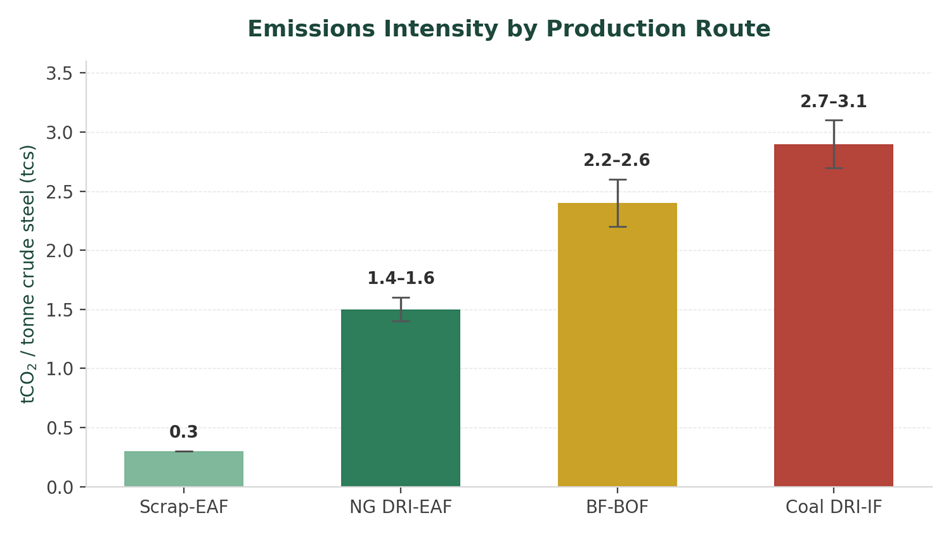
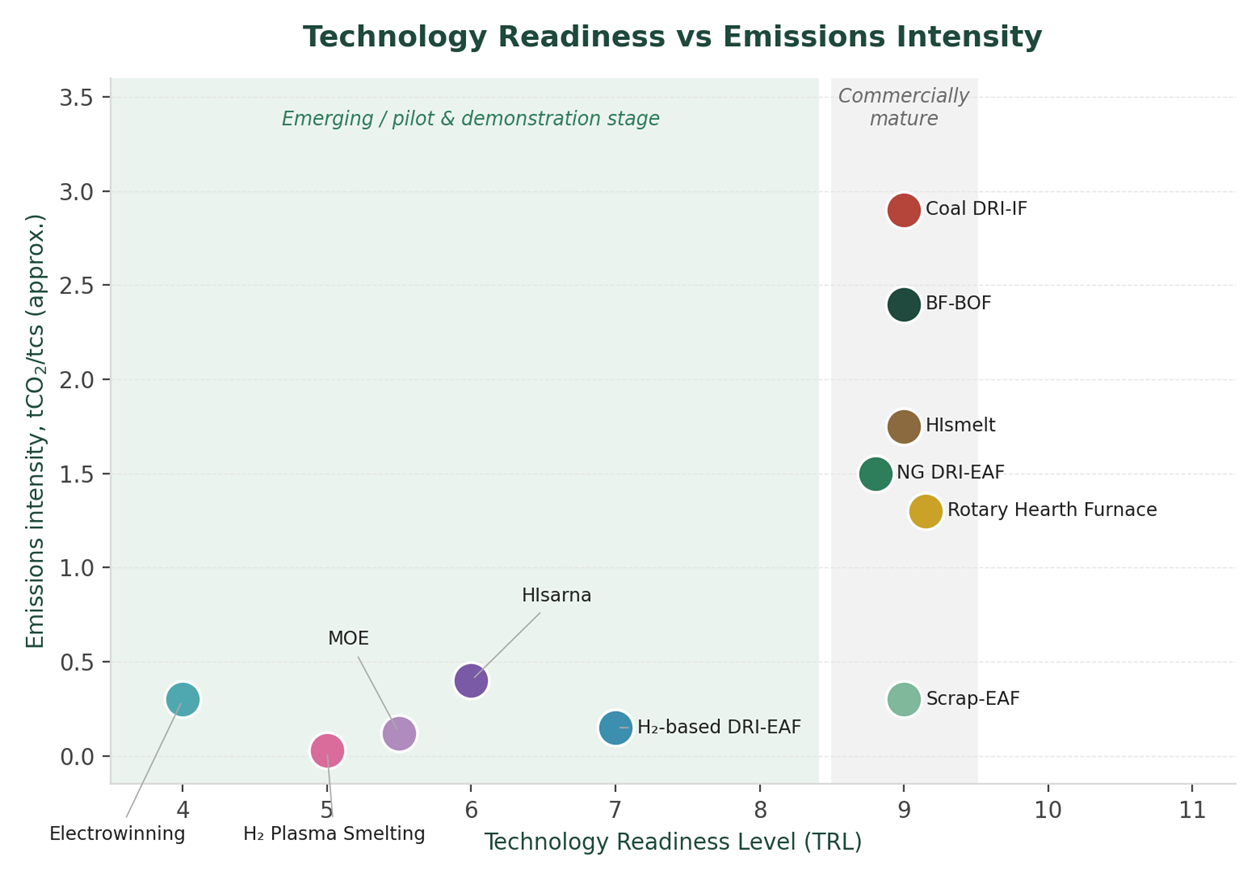
Conventional steelmaking still dominates production, but a spectrum of technologies from commercially mature routes to early-stage breakthroughs is emerging to decarbonise the sector. These vary widely in maturity, emissions-reduction potential, and commercial readiness.
|
Technique
|
Emissions
|
TRL
|
National / global examples
|
|
BF–BOF
|
2.2–2.6 tCO₂/tcs
|
9
|
National: SAIL, Tata Steel
|
|
Coal DRI–IF
|
2.7–3.1 tCO₂/tcs
|
9
|
National: JSPL, JSW
|
|
NG DRI–EAF
|
1.4–1.6 tCO₂/tcs
|
9
|
National: Tata, JSW, JSPL
|
|
Scrap–EAF
|
~0.3 tCO₂/tcs
|
9
|
National: JSW, Kalyani Steel
|
|
HIsmelt
|
1.6 tCO₂/thm
|
9
|
Global: Rio Tinto, Nucor, Kwinana (Australia)
|
|
Rotary Hearth Furnace
|
1.3–1.6 tCO₂/tcs
|
9
|
Global: Nippon Steel, POSCO (Korea)
|
|
Hydrogen-based DRI–EAF
|
Near zero (with H₂ + RE)
|
6–8
|
National: Tata, JSW, Jindal Stainless, CSIR–IMMT;
Global: HYBRIT, H2 Green Steel
|
|
HIsarna
|
0.4 tCO₂/tcs (after CCS)
|
6
|
National: Tata Steel India;
Global: Tata Steel Ijmuiden, Rio Tinto
|
|
Molten Oxide Electrolysis
|
Near zero (with RE)
|
5–6
|
Global: Boston Metal (produced >1 tonne of iron at pilot scale)
|
|
Electrowinning
|
~0.3 tCO₂/tcs
|
5-6
|
Global: SIDERWIN consortium, led by ArcelorMittal
(pilot has produced ~4 kg of iron)
|
|
Hydrogen Plasma Smelting
|
Zero (with RE)
|
5
|
National: CSIR–IMMT;
Global: SuSteel (Austria)
|
Four decarbonisation levers
Reaching net-zero by 2070 requires coordinated action across four interconnected levers, not sequential silos, but a portfolio deployed in parallel and sequenced by feasibility.
|
PILLAR 01 Renewable electricity integration Scale renewable power in steel operations toward the 43.33% RPO target by 2030, cutting the emission factor from 2.54 to 2.35 tCO₂/tcs, an 8% reduction at the grid-mix level. |
PILLAR 02 Carbon capture, utilisation & storage Deploy CCUS across BF–BOF routes, where ~56% of current emissions can only be abated this way. Requires dedicated CO₂ transport, utilisation and storage infrastructure. |
|
PILLAR 03 Biomass & circularity Scale biochar injection (up to 1.19 tCO₂/tcs reduction potential) and expand scrap-based EAF, supported by the Steel Scrap Recycling Policy and Vehicle Scrappage Policy. |
PILLAR 04 Process transition & material efficiency Shift capacity toward DRI–EAF and hydrogen-based routes; adopt best available technologies (BAT) across ISPs and SSIs, backed by an estimated ₹23,257 crore in CAPEX. |
Anatomy of a tonne of steel
Primary and secondary steelmaking pull emissions from different points in the process which matters, because it determines which decarbonisation lever pays off first. Both routes run through material prep, iron reduction, melting/refining, and rolling; the two flows below show where each carries its heaviest load.
Primary steel: BF–BOF route
The blast furnace carries the bulk of the emissions load in this route, as coke and coal serve both as fuels and chemical reducing agents. Therefore, this stage cannot simply be electrified and requires alternative solutions such as hydrogen, biochar, or CCU.
Secondary steel: Coal DRI–IF route
Here the load sits with the rotary kiln, India's coal-based DRI relies on high-ash non-coking coal with inherently lower combustion efficiency than the alternatives, which is why Coal DRI–IF carries the highest emissions intensity of any route in commercial use today.
Where routes fall on the taxonomy
India's Green Steel definition sets the line at an emissions intensity below 2.2 tCO₂ per tonne of finished steel (tfs) expressed as a % ‘greenness’ relative to that threshold. Plotting each production route against it shows how far conventional routes sit from the line, and how close some transition options already are.

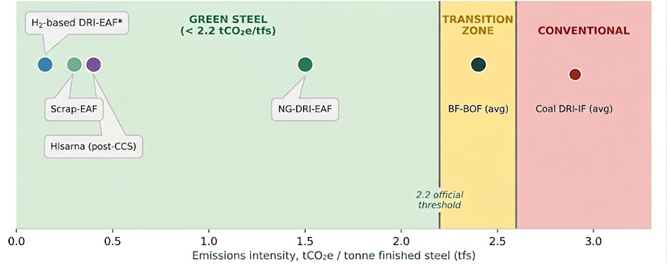
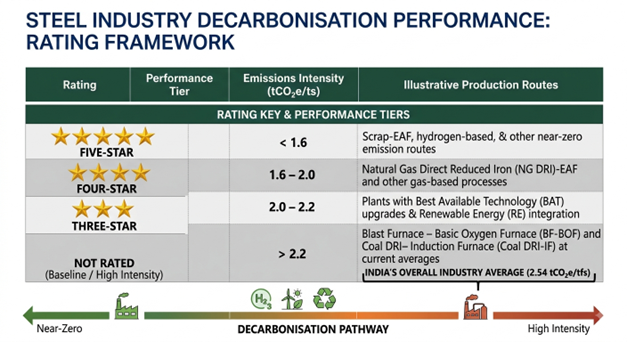
India's Ministry of Steel notified the Green Steel Taxonomy [5] via Gazette Notification No. 763(E) on 12 December 2024, the first such taxonomy released by any country. It certifies steel on a four-tier star rating based on emissions intensity (Scope 1 + Scope 2 + a limited Scope 3 covering sintering, pellet-making, coke-making and purchased raw materials, excluding mining/transport/downstream use), with the National Institute of Secondary Steel Technology (NISST) as the certifying body. Certificates are issued annually and thresholds are reviewed every three years.
The policy landscape
Seven overlapping policy instruments currently shape India's steel decarbonisation push spanning energy efficiency mandates, procurement preference, scrap recycling, green hydrogen, and carbon markets.
|
Policy
|
Objective
|
|
Perform, Achieve and Trade (PAT), 2012
|
Improve energy efficiency and reduce GHG emissions via Specific Energy Consumption
(SEC) targets and tradable Energy Saving Certificates (ESCerts).
|
|
National Steel Policy (NSP), 2017
|
Expand capacity, improve raw material security, promote R&D. Targets
300 MTPA capacity and 160 kg per-capita consumption by 2030–31.
|
|
DMI&SP Policy, 2017
|
Promotes domestically manufactured iron & steel in government procurement,
preferencing products with ≥15% domestic value addition.
|
|
Steel Scrap Recycling Policy, 2019
|
Establishes an organised scrap recycling ecosystem to improve domestic
scrap availability and support decarbonisation.
|
|
Vehicle Scrappage Policy, 2021
|
Increases domestic ferrous scrap availability through scientific scrapping
of end-of-life vehicles.
|
|
National Green Hydrogen Mission, 2023
|
Promotes green hydrogen for hard-to-abate sectors incl. steel; targets
5 MTPA production backed by 125 GW renewable capacity by 2030.
|
|
Carbon Credit Trading Scheme, 2023
|
Establishes the Indian Carbon Market through emission-intensity targets
and carbon credit trading.
|
What it costs and what it doesn't
- ₹23,257 crore in estimated CAPEX to deploy Best Available Technologies (BAT) across Integrated and Secondary Steel plants.
- ₹73,861 crore required to reach 43.33% renewable electricity penetration in the sector by 2030–31 (assuming 50:50 solar–wind hybridisation).
- Steel accounts for only ~18% of total infrastructure project cost replacing 20% of conventional steel with a 30%-premium green steel raises total project cost by just ~1.1%. Even 100% green procurement adds only 1.83–5.50%.
- Green hydrogen-based steel carries a 50–70% premium today, projected to fall to 20–29% by 2030–31 as scale, renewable costs, and hydrogen production costs improve.
- Near-zero BF–BOF steel via CCUS carries a 20–68% premium, based on an assumed CO₂ capture cost of USD 50–92/tCO₂. Around 56% of BF–BOF emissions can only be abated through this pathway.
How the transition is sequenced
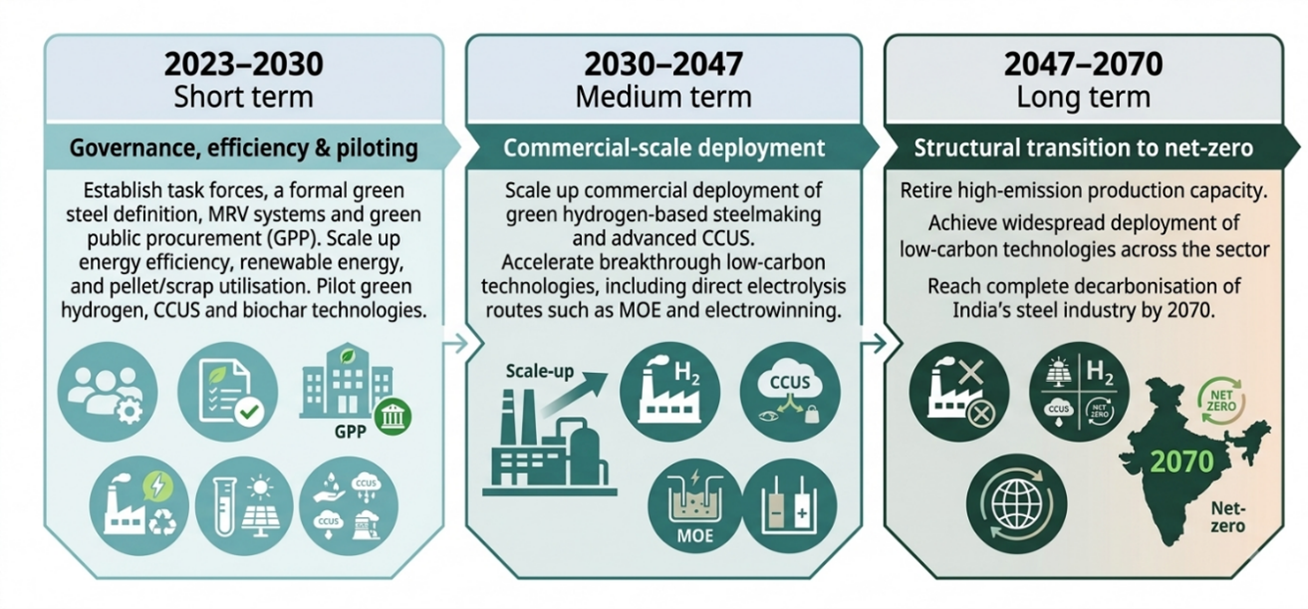
The roadmap to a net-zero steel sector by 2070 unfolds across three phases each building the conditions for the next.
What next?
If this is a space you're working in steel procurement, decarbonisation financing, or applied R&D we would love to speak.
As per our research few potential action points are listed below:
- Create demand for green steel: Use public procurement and large infrastructure projects to introduce minimum emissions-intensity criteria and gradually increase the share of low-carbon steel purchased.
- Use pilots to de-risk the transition: Select a few high-emission steel plants and applications for technology demonstrations, measure actual emissions reductions, and use the results to inform wider-scale investment and policy.
- Pushing MSME potential for green steel: Build awareness and provide targeted technical support to MSME steel producers to adopt lower-emission production routes, enabling their transition towards green steel while contributing to India’s NDC and long-term decarbonisation goals.
Green Steel Transition | Industrial Decarbonization | Energy Efficiency | GHG Accounting | Carbon Reduction Strategies | Low-Carbon Technologies
Greenletter is GreenTree's periodic newsletter on energy efficiency, sustainability, and market transformation across India's buildings and industry sectors.
References
- https://www.steel.gov.in/national-steel-policy-nsp-2017?utm
- https://www.pib.gov.in/PressReleasePage.aspx?PRID=2082773&lang=2®=48&utm
- https://ieefa.org/sites/default/files/2023-09/Steel%20Decarbonisation%20in%20India_September%202023_2.pdf
- https://steel.gov.in/sites/default/files/2025-11/GSI%20Report%20FINAL%20NEW_18092025_2.pdf
- https://steel.gov.in/sites/default/files/2025-03/Taxonomy%20Brochure.pdf
Authored by: Anurag Bajpai, Priya Kumari, Tanya Saini, Himanshu Sharma


Follow our activities on Twitter | Linkedin | Youtube | Instagram | Facebook